The New SME Stack — 10 Layers Every Modern Business Needs
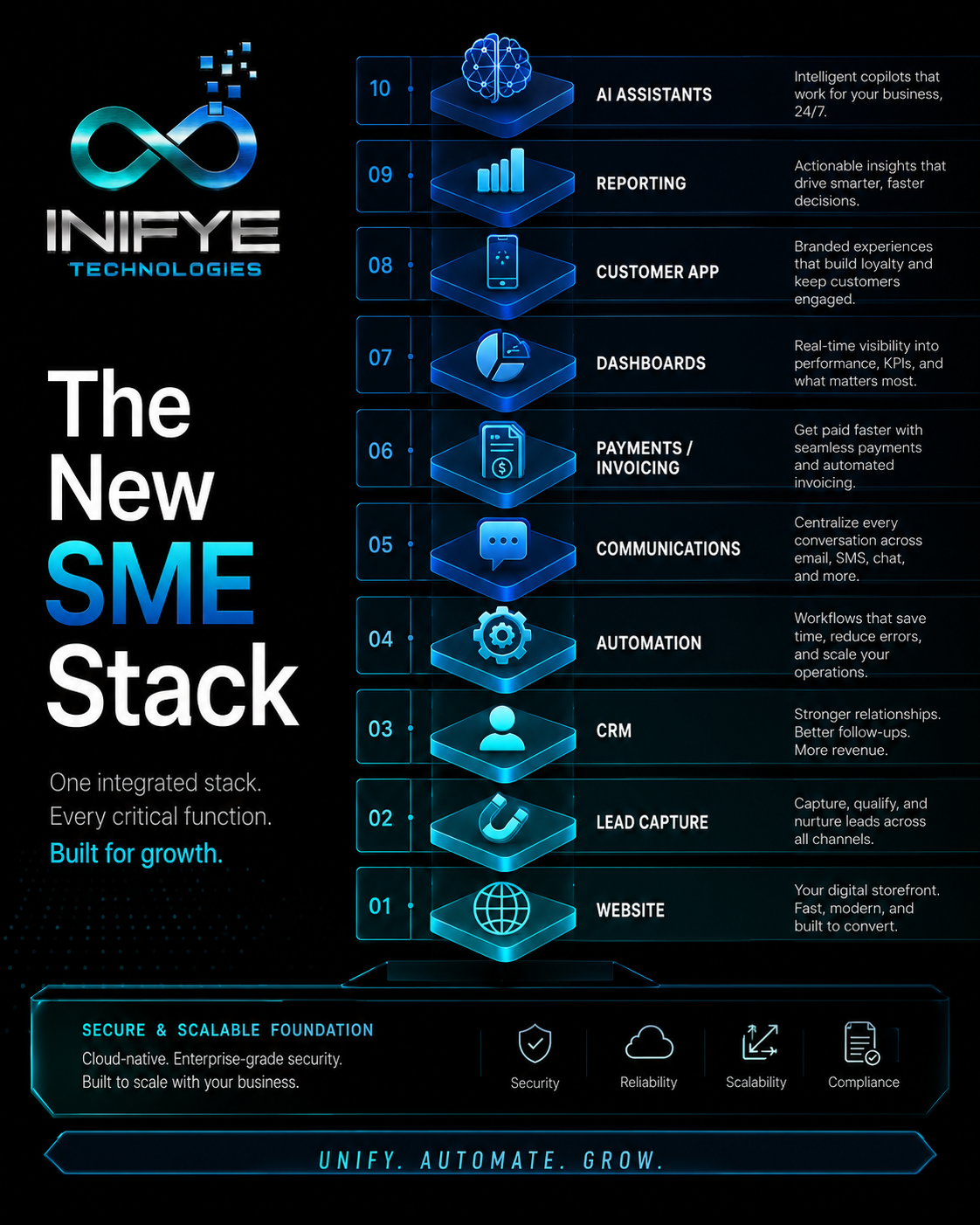
The new SME stack is ten integrated layers — website, lead capture, CRM, automation, communications, payments, dashboards, customer app, reporting, and AI assistants — sitting on a cloud-native, enterprise-grade secure foundation. Together they replace 10–15 disconnected SaaS tools.
What does a complete modern technology stack for an SME look like in 2026?
The new SME stack is ten integrated layers — website, lead capture, CRM, automation, communications, payments, dashboards, customer app, reporting, and AI assistants — sitting on a cloud-native, enterprise-grade secure foundation. Together they replace 10–15 disconnected SaaS tools.
- ▸01 Website — Fast, modern, built to convert
- ▸02 Lead Capture — Capture, qualify, nurture leads across all channels
- ▸03 CRM — Stronger relationships and better follow-ups
- ▸04 Automation — Workflows that save time and reduce errors
- ▸05 Communications — Centralize email, SMS, chat in one inbox
- ▸06 Payments / Invoicing — Get paid faster with automated invoicing
- ▸07 Dashboards — Real-time visibility into KPIs
- ▸08 Customer App — Branded experiences that build loyalty
- ▸09 Reporting — Actionable insights that drive smarter decisions
- ▸10 AI Assistants — Intelligent copilots that work 24/7
- ▸Foundation — Cloud-native, enterprise-grade security and compliance
Frequently Asked Questions
Do SMEs really need all 10 layers?
Yes — but not all at once. Most businesses already have 4–6 of these as disconnected tools (a website, a CRM, an email tool). The stack works by integrating them, then progressively adding the missing layers.
What is the difference between an automation layer and an AI assistant layer?
Automation executes pre-defined rules (if X then Y). AI assistants reason, decide, and act on novel inputs — they handle exceptions automation can't.