How AI Changes Business Operations — Traditional vs AI-Assisted
Across six business functions, traditional manual workflows give way to AI-assisted equivalents that close more deals, save time, raise customer satisfaction, run leaner, surface faster insights, and produce data-driven strategy. AI doesn't replace people — it empowers them.
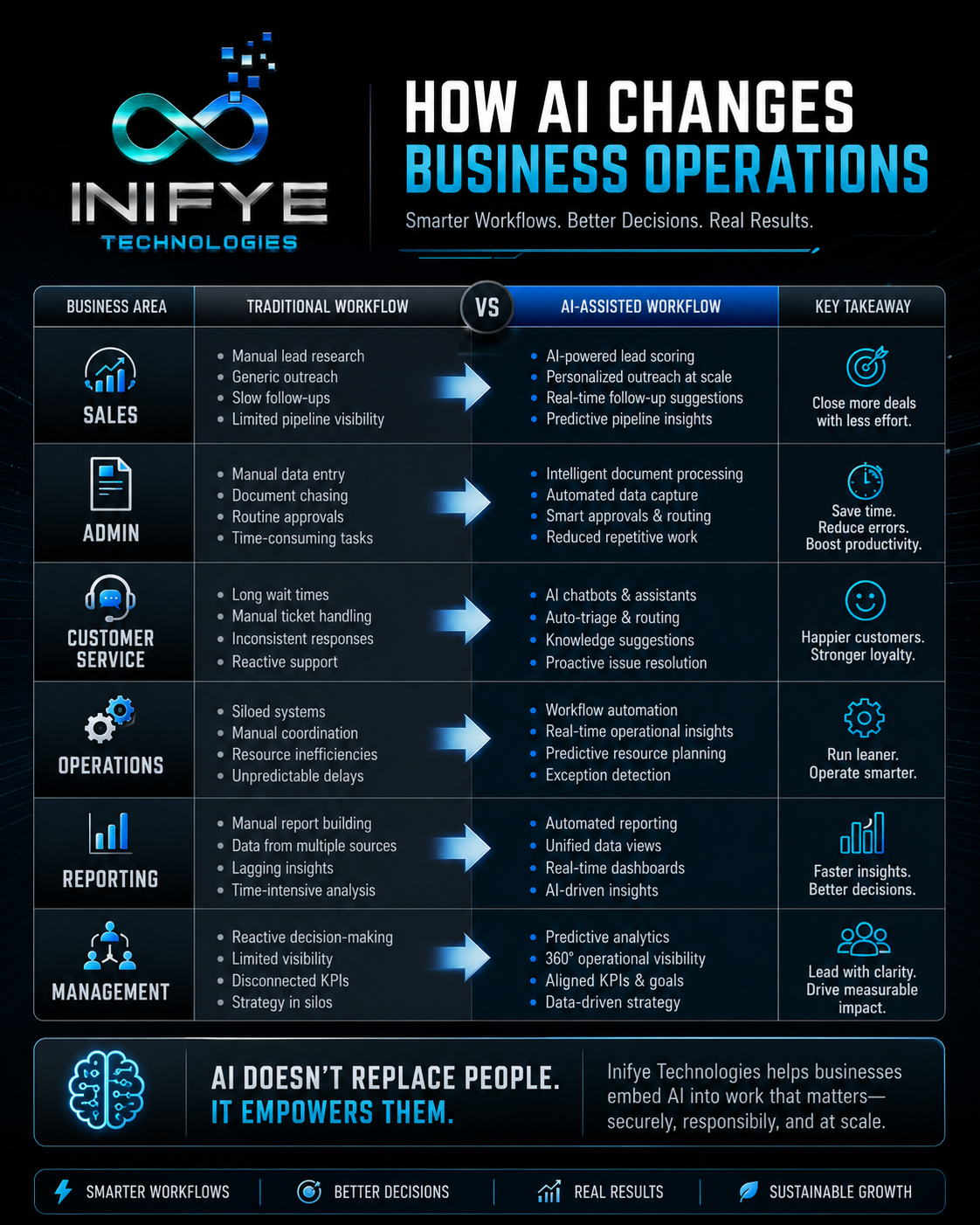
How does an AI-assisted workflow compare to a traditional one across sales, admin, customer service, operations, reporting, and management?
Across six business functions, traditional manual workflows give way to AI-assisted equivalents that close more deals, save time, raise customer satisfaction, run leaner, surface faster insights, and produce data-driven strategy. AI doesn't replace people — it empowers them.
- ▸Sales: manual lead research → AI lead scoring + personalized outreach + predictive pipeline
- ▸Admin: manual data entry → intelligent document processing + smart approvals
- ▸Customer Service: long wait times → AI chatbots + auto-triage + proactive resolution
- ▸Operations: siloed systems → workflow automation + predictive resource planning
- ▸Reporting: manual report building → automated reporting + unified data views
- ▸Management: reactive decisions → predictive analytics + 360° visibility
Frequently Asked Questions
Which function should a business AI-enable first?
Sales typically pays back fastest because revenue lift is direct and measurable within 30–60 days. Admin is the second-fastest win.
Does AI-assisted customer service actually improve satisfaction?
Yes — when paired with a clean knowledge base. Auto-triage and instant answers cut wait times, and human agents focus on complex cases. CSAT typically rises 20–40%.